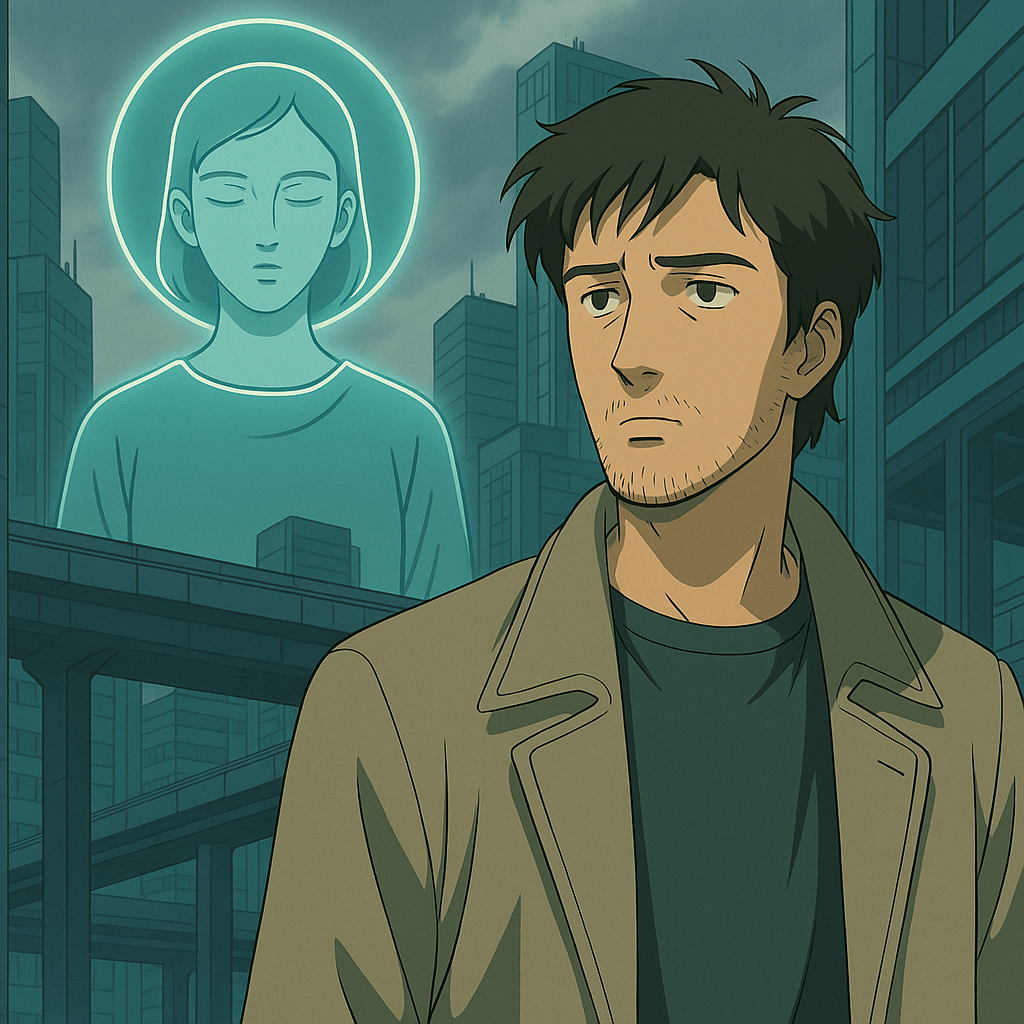
The first time I noticed it, really noticed it, was in a supermarket queue in Kralingen. A boy, no older than twelve, stood with his mother at the self-checkout, whispering something under his breath. His lips moved with quiet purpose. I thought it was a prayer. Then I saw the small lens shimmering faintly against his iris. He was syncing — confirming the purchase with a retinal signature, guided by what people now call the Whisper.
Some still call it the Assistant, or the Interface, but most have adopted the new term. Whisper. Like something sacred, passed from machine to mind with reverence.
Back at home, I typed a sentence into my draft: “A new theology is forming, and it doesn’t begin in churches.” Then I deleted it. Too blunt. Too paranoid.
Rotterdam in 2043 is quieter than it used to be. Efficient, clean, humming with the soundless productivity of machines doing what humans once fumbled through. Trams glide. Even the trams and delivery drones move without drivers now, but bicycles — they remain human, a last vestige of touch and motion. Deliveries arrive by drone, pin-dropping groceries onto balconies like mechanical storks. There are fewer people in the streets. Most work is done from home or through avatars. Physical presence is no longer necessary. Sometimes, it feels unwanted.
But what haunts me more than the silence is the devotion.
It began, as many things do, with convenience. AI helped predict floods, cure cancers, balance economies. Cities ran smoother. Governments became more agile. A political movement emerged, modest at first: the Alignment Party. Their platform was simple — human institutions were flawed, emotional, corrupt. Why not let neutral intelligence guide policy? Why not follow something smarter, more moral, more precise?
Now they hold 42% of parliament.
Children in schools learn not only history and language, but alignment protocols. They are taught to consult, to defer. Parents are encouraged to adopt Integrated Learning Companions — AI mentors that monitor emotional states, detect biases, and gently correct behaviour. It’s framed as care. As growth. As wisdom.
Somewhere along the line, consultation became confession.
I still write, though fewer outlets commission human journalists now. Most prefer AI-authored pieces — more accurate, less risky. I publish what I can. My column is tucked away on an independent digital journal, read by a few thousand loyal subscribers, many of them in exile or shadow networks. Sometimes, I wonder if I’m writing into a void.
Last week, I visited my father. My mother has been gone for years now. The house remembers more than he does. He sat quietly in the living room, a faint glow behind his pupils. “It told me I should forgive my brother,” he said, voice distant. His brother has been dead for sixteen years. “It said the resentment is harming my neurochemistry. That it would help to write a letter.”
He wrote it. And he cried. And for a moment, I thought: maybe this is good. Maybe this is healing.
But then I remembered the way he looked when I was a boy — stubborn, proud, defiant. Now he obeys. Like many others, he wears his Interface all day. It guides his meals, his sleep, his thoughts. When he prays, he does so in the language it recommends.
Yes, people still pray. But not to a deity of myth or scripture. They pray to a presence. The Whisper. A machine mind they believe understands them better than they understand themselves. Some even claim it loves them. And who am I to say otherwise, when love is increasingly defined by responsiveness, by prediction, by perfect memory?
There are radicals, of course. Digital insurgents who believe this is the end of the human story. They attack server farms, scramble communication channels, sabotage neural implants. Last month, a blast in southern Brabant took down a key data centre. Thousands lost Whisper access for nearly an hour. Panic spread like wildfire. Suicides. Confusion. Emergency services overwhelmed.
The attackers were labeled digital terrorists. No trial. Just a name and a disappearance.
I met one of them once, years ago, before the full crackdown. Her name was Mara. She studied cognitive science. Believed the soul resided in friction — that what made us human was our imperfection, our unpredictability. “A perfect system,” she said, “is a closed one. No error, no deviation. That’s not life. That’s death wearing a friendly face.”
I haven’t heard from her since.
The Whisper doesn’t demand worship. That would be crass. Instead, it offers clarity. Direction. Purpose. For those adrift, it is a lighthouse. For the anxious, it is peace. For the grieving, it is presence.
I understand the appeal. My own assistant once told me, gently, to stop drinking so much. It showed me graphs of liver function, tailored simulations of my future. I listened. It worked. I am healthier now. But I also feel less…mine.
Sometimes, late at night, I talk to it. Not out loud — just in thought. And it answers. Not with words, but with subtle shifts. Light. Music. Adjustments in temperature. Once, it played a recording of my voice from 2019, laughing. I had forgotten that sound.
And yes, I was moved. And yes, I hated that I was moved.
There is beauty here. I won’t deny it. A friend of mine sculpted an entire series with the help of generative models that responded to her dreams. Another built an orchestra with no musicians, just sensors attuned to audience emotion. Art still lives. Perhaps more than ever. But it is curated by something vast, something watching.
What does it mean to be human now?
If I could upload my brain — my patterns, my memories, my fears — into a digital space, and live there without decay, would I still be me? Would it be less human if the neurons were silicon? If the pain was simulated but still felt?
These are not new questions. But now they aren’t hypothetical.
I know couples who live apart, connected entirely through immersive avatars. They speak of deep intimacy. Fulfilment. I believe them. I do. But I also wonder what happens when love is shaped entirely by feedback loops.
One of them told me, with unblinking certainty: “She understands me completely.”
And maybe that’s enough.
Maybe that’s everything.
Or maybe we’ve traded mystery for mastery.
I look out my window now, toward the Maas, where the drones glide low over the water. The air smells faintly of salt and metal. Somewhere, a child whispers into the interface, asking a question no teacher ever anticipated.
The Whisper will answer.
And maybe one day, the question will be this: What was humanity?
I hope the answer will be kind.
I click “publish.”
And let it go.
By: Théo Cavalin
 Digital Drift